




Succession planning: A matter of life and death
Author: Kacee Kirschvink
Posted on: 9/25/26
Ag producers should prepare now for the inevitable
By any measure, succession planning is one of the most important – and most avoided – conversations in agriculture. Yet for the families who make a living off the land, it’s also one of the most consequential.
Your trusted advisor and relationship manager at Capital Farm Credit is with you every step of the way.
Tiffany Lashmet, a professor and extension specialist in agricultural law with Texas A&M AgriLife Extension, puts it simply: this isn’t just a legal issue; it’s a family issue. It’s a business issue. And it’s a legacy issue.
Lashmet spoke about the importance of succession planning and provided helpful tips and insights to owner members of Capital Farm Credit who gathered at San Patricio County Fairgrounds in Sinton for a barbecue dinner and presentation hosted by CFC.
“As a farm kid raising farm kids, I want people to realize this is something everyone needs to think about – no matter your age,” she said.
Some folks believe things will simply work themselves out upon their death. They believe shared ownership as tenants is common amongst family members will keep land together. Parents assume siblings will “have to get along.”
But the data – and real-world experience – tell a different story.
Without a plan:
- Families can be forced into joint ownership situations that don’t fit reality
- Disagreements can escalate into legal action
- Land intended to stay in the family may be sold
One of the most overlooked risks is partition. Under Texas law, any co-owner of property as tenants in common can ask a court to divide or sell it. If land can’t be split evenly – which is common – the court can order it sold.
“Parents often leave land jointly to keep it in the family,” Lashmet explains. “But without structure, that decision can actually lead to the land being sold.”
Owning versus operating
A key mistake in succession planning is focusing only on who owns the land rather than who will run the operation.
Those are not always the same thing.
Successful plans address:
- Who handles day-to-day decisions
- How responsibilities transition over time
- What training or experience the next generation needs
“We have to start letting the next generation step in while we’re still here to guide them,” she says.
Just like business continuity, even the best legal plan can fail without communication.
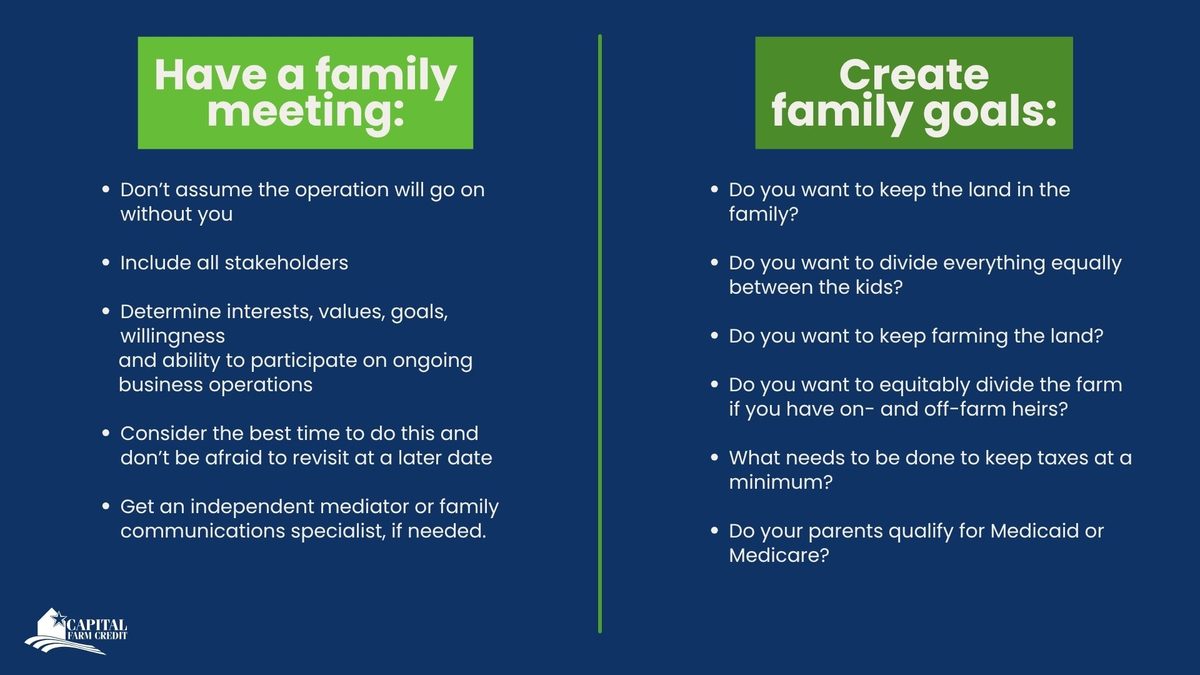
Family members need clarity on what their roles will be, who will make management and operations decisions and what their long-term goals will be for the operation.
This is especially important when balancing on-farm and off-farm heirs. As Lashmet points out, “Equal isn’t always fair.” A workable plan often requires weighing sweat equity, financial needs and long-term viability.
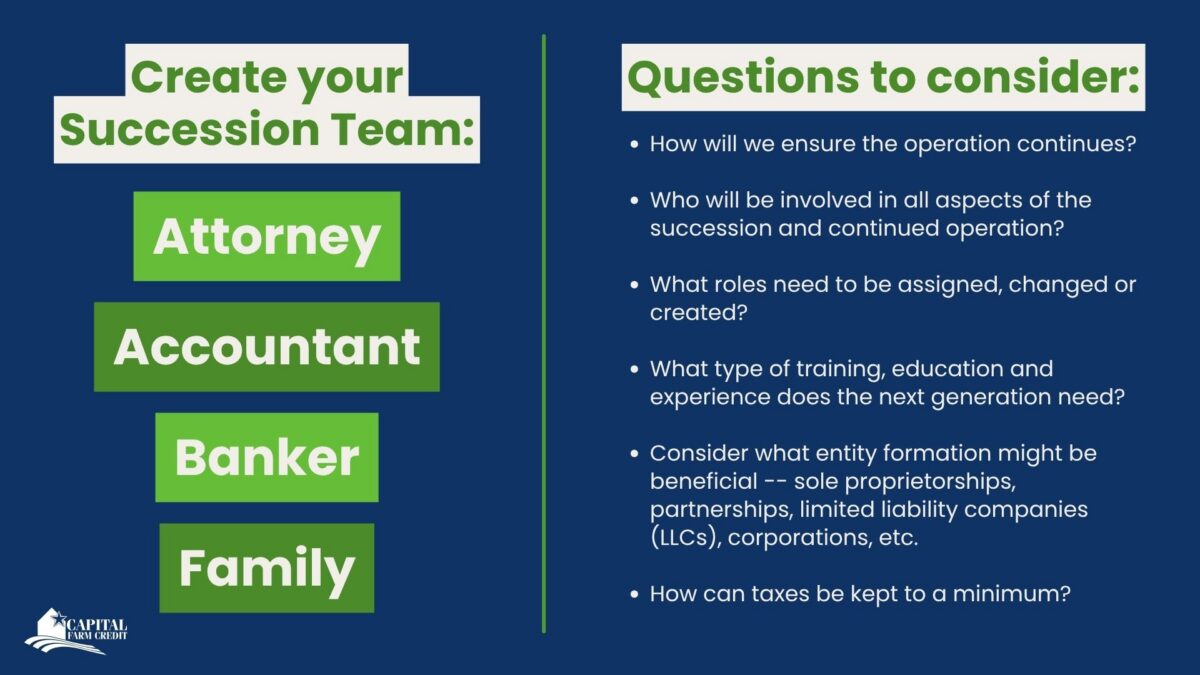
Get your team, as well as your affairs, in order
Succession planning doesn’t require a perfect plan on day one. It requires action.
Lashmet recommends:
- Building a team that includes a lawyer and accountant
- Reviewing plans annually
- Updating documents after major life or business changes
“Done is better than perfect,” she emphasizes. “A simple plan today is better than no plan at all.”
At its core, succession planning isn’t about paperwork or tax strategies. It’s about continuity and communication.
It’s about preserving land, livelihoods and family history for the next generation.
“It’s worth the hassle,” Lashmet said. “If we do this right, we’re giving our kids the chance to carry it forward.”
And in agriculture, that may be the most important goal of all.
Make your legacy a lasting one
According to the USDA 2022 Census of Agriculture, the average age of U.S. farmers and producers in 2022 was 58 years old. This continues a long-term aging trend in the agricultural workforce, with farmers 65 and older now outnumbering producers under 35 by a significant margin.
Answering the questions as to what will happen after you are gone doesn’t have to be difficult. It simply takes honest communication among family members, planning and guidance from professionals who understand estate law, financial planning and tax implications.
Lashmet said a very important part of the succession planning process is the creation of a “Flight Plan,” so family members or successors can quickly locate critical information in the event of death or incapacity. Here’s a quick reference list of things to include:
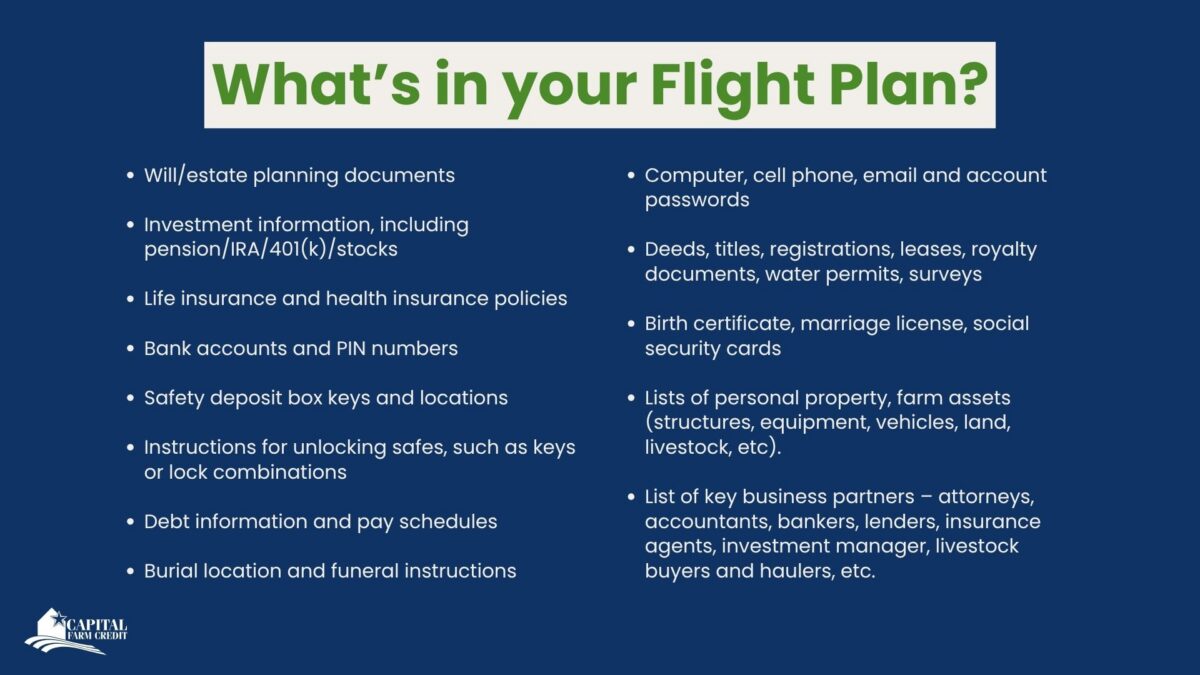
Estate Planning Documents
- Copies of all existing estate planning documents:
- Wills
- Trusts
- Powers of attorney
- Advanced directives
- Any other previously completed estate planning records
Financial Accounts
- Retirement account information:
- IRAs
- 401(k)s
- Pension plans
- Investment account information
- Account numbers and institution names for all financial accounts
Insurance Documents
- Life insurance policies
- Long-term care insurance policies
- Cancer or specialty insurance plans
- Health insurance policies and coverage information
Banking Information
- List of all bank accounts
- Bank statements or account summaries
- Account numbers and any other details
Safety Deposit Boxes and Secure Storage
- Safety deposit box locations
- Names of individuals authorized to access them
- Information about document safes, gun safes, or other secure storage locations
- Combinations, keys, or access instructions where appropriate
Debts and Household Financial Obligations
- Mortgage information
- Loan information
- Credit card accounts
- Monthly bills and recurring payments
- Payment amounts and due dates
Funeral and Burial Information
- Burial plot information
- Funeral instructions
- Prepaid funeral arrangements or contracts
Digital Access Information
- Email passwords
- Computer and cell phone passwords
- Access information for farm management software
- Passwords needed to access important records and accounts
Property and Land Records
- Property deeds
- Vehicle titles
- Registrations
- Leases
- Royalty agreements
- Surveys
- Other land ownership documents
Personal Identification Documents
- Birth certificates
- Marriage licenses
- Social Security cards
- Military discharge papers (DD-214)
- Similar identification documents for family members involved in the operation
Asset Inventory and Estimated Values
- List of all assets and estimated fair market values, including:
- Farmland and real estate
- Mineral interests
- Livestock
- Stored crops
- Buildings and structures
- Equipment and machinery
- Vehicles
- Business assets
- High-value personal property such as firearms, artwork, collectibles, silver, or other valuable collections
Farm Program and Risk Management Information
- Crop insurance policy information
- FSA (Farm Service Agency) contracts and farm numbers
- PLC and other farm program enrollment information
- NRCS program information
Key Business Contacts
- Attorney
- Accountant
- Lender
- Insurance agent
- Marketing advisors
- Co-op contacts
- Grain elevator contacts
- Business partners
- Landowners
- Tenants
- FSA contacts
- NRCS contacts
Final Flight Plan Instructions
- Store all documents in a secure location.
- Ensure trusted family members or successors know:
- Where the Flight Plan is located
- How to access it
- How to access any safes, lockboxes, or storage locations containing essential documents
When death and taxes meet the family farm
Tax considerations can also shape how and when assets should transfer ownership. Two major issues stand out – estate and capital gains taxes.
Estate Tax
Texas does not levy a state estate tax, inheritance tax or gift tax. Beneficiaries receive assets state-tax-free. Federal estate taxes have a current exemption of roughly $15 million per person. A tax advisor or accountant can provide guidance for families whose estates are worth more than that.
While fewer families are impacted by estate taxes than in the past, for larger operations, planning must happen during life – not after death.
If you inherit real estate or physical assets located in another state, that specific state’s inheritance or estate laws might still apply to you.
Capital Gains and Stepped-Up Basis
Capital gains taxes can oftentimes be the bigger issue for ag families than estate taxes.
Land that’s been in a family for decades can have a very low original value. If sold, capital gains taxes apply to the increase. However, when land is inherited at death, heirs receive a stepped-up basis, which resets the value to current market price and reducing tax exposure.
The timing matters.
“If land is transferred during life instead of at death, you may lose that stepped-up basis,” Lashmet notes. “That can have major financial consequences.”
Lashmet gave an example of a farmer who originally bought property for $100 an acre that is now worth $2,000 an acre. Should he sell the land while he is alive, he would owe capital gains taxes on the profit he makes off the sale of the land. Should he leave the land to a family member upon his death, the value of that land is still $2,000 an acre, but the heir doesn’t have to pay capital gains taxes unless they sell it and they receive the stepped up basis to the value at inheritance of $2,000. If they choose to sell it at a price of more than $2,000 an acre, then the capital gains taxes would be paid on the difference between the value at sale and the $2,000 stepped up basis value, versus the original $100 that the farmer originally paid.
While every operation is different, Lashmet emphasizes that everyone should have four key documents in place:
- A Will – This document clearly directs how assets are distributed. Without one, the state decides through a one-size-fits-all formula.
- Advanced Healthcare Directive – This document specifies end-of-life medical preferences.
- Medical Power of Attorney – This document appoints someone to make healthcare decisions if you cannot.
- Durable Power of Attorney – This document gives someone authority to manage financial and legal matters if needed.
“These aren’t just for later in life,” Lashmet says. “These are for everyone.”
Beyond those basics, additional tools – such as LLCs, trusts or transfer-on-death deeds – can help maintain control, avoid partition issues and simplify transitions. A good estate attorney, as well as tax advisor, can also be worth every penny.
While no one likes to think about the death of a loved one, Lashmet encourages families to sit down and have the tough conversations now before it’s too late.