


Stay alert for farmer fraud
Author: Kacee Kirschvink
Posted on: 12/1/25
You may feel like you live in the middle-of-nowhere, Texas, but scammers can still find you!
At this year’s Capital Farm Credit AgriRoots Conference, attendees learned that fraud can be big business for scammers, especially as technology and Artificial Intelligence (AI) evolves.
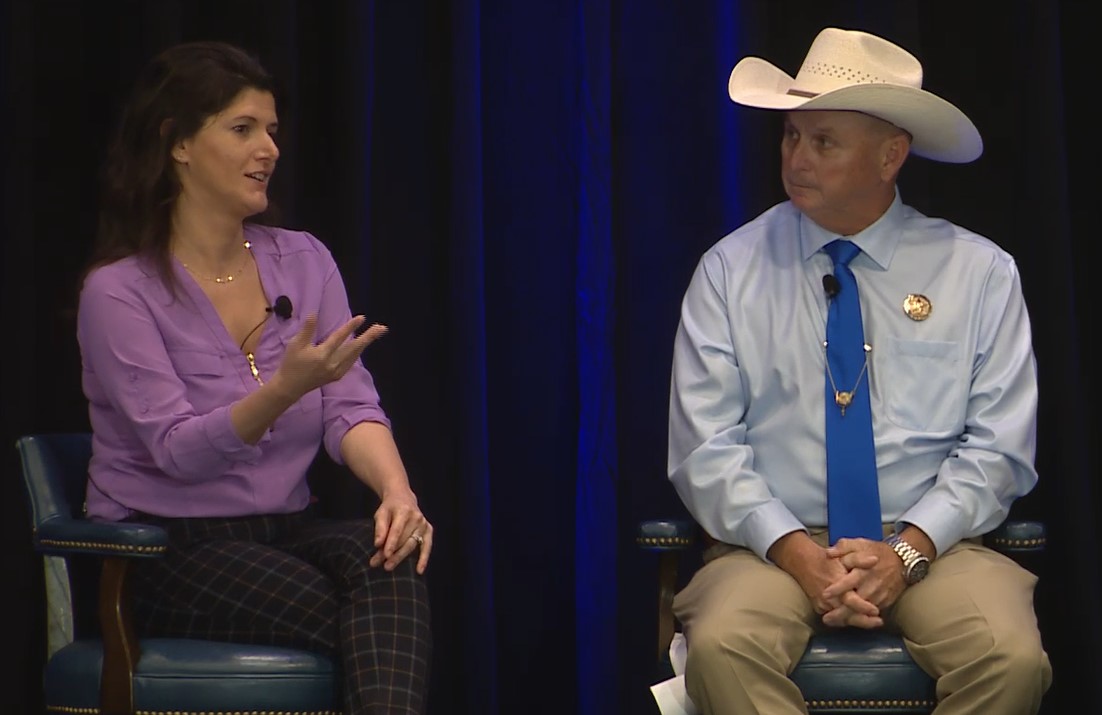
Brent Mast, special ranger for the Texas and Southwestern Cattle Raisers Association, and Bora Manzanares, manager of Financial Crimes Compliance with CoBank, joined CFC’s Senior Vice President of Missions and YBS Allyson Tjoelker for the interesting topic: “From Field to Fraud: Uncovering Hidden Risks.” They explained common fraud schemes and offered practical strategies to safeguard the supply chain.
AgriRoots, an initiative by Capital Farm Credit, supports emerging farmers, ranchers and agribusiness owners by providing resources, financial literacy and loans to build sustainable and successful agricultural operations.
When people think of theft against farmers, they used to think about livestock or machinery theft. But gone are the days of simply cutting a wire fence and stealing cattle, Mast said. Of course, that still occurs, but he said much of the fraud he investigates involves online theft, white collar crime and bank fraud.
“What we typically see is fraud involving internet purchases,” he said. “People are advertising horses or cattle for sale on a website, Facebook Marketplace, whatever it is, and you usually communicate with them by text and never by phone. Basically, you send the money, and you don’t get what you paid for.”
By the time the scam was discovered, the money has left the country, and it is very hard to get back, he said.
In a recent case, criminals spoofed an actual ranch’s website, sold a horse online and stole $9,000 from a buyer. To this day, the ranch owners still have people coming to their location expecting to pick up a miniature Highland cow that they unknowingly purchased in the online scam.
Manzanares, who works for the largest financial institution in the Farm Credit System, said she sees similar cases involving machinery and equipment, grain payments and vendor fraud. She said social engineering is increasingly common, where a person believes they are paying a legitimate party when in actuality, they are paying a scammer.
“Social engineering is really just an aspect of the human tendency to trust,” she said. “Fraudsters use manipulation tactics to trick our customers – our borrowers, our producers – to send money to someone that is not truly the person they think they are sending money to.”
If someone calls and reports a change in their bank account numbers, addresses or phone numbers, she said to be skeptical and call to independently verify the change.
Mast agreed.
“In a rural culture, you want to trust people. How many millions of dollars of cattle change hands with a handshake?” he said. “I see a lot of older people that just don’t understand how easy that technology allows a crook to steal when you move away from face-to-face transactions.”
Both Mast and Manzanares gave attendees some tips to look for in spotting a scam:
- When buying items off the internet, examine the picture. Does it look like the environment is right for the location, or it is showing mountains or a desert in the background when the animal for sale is not in a mountain or desert location.
- You can use Google Earth to look at the location and determine if the photo appears where someone claims it is.
- Use Google to do a reverse search of the photo to see if it is being used on other websites. If so, that could be a sign that it is not legitimate.
- Be leery if someone wants a deposit up front or provides a sense of urgency to the transaction.
- Don’t just depend on a video to see the item you are purchasing. Do a live video call where you can see the animal to ensure it isn’t just a fake video.
- If someone wants to buy an animal from you or wants to do business with you without asking specific questions or providing conflicting information, beware that it may be a scammer trying to fool you.
- If someone sends you a cashier’s check with extra money for shipping and then wants you to reimburse them, it is commonly a scam. The check is fake, and you are out money.
- If a voice on the phone sounds fake or computer-generated, it could be a scam.
- If a phone call has an odd ringtone, it could be that a scammer is intercepting the phone call, and you are talking to a fraudster.
“You have to take a step back and realize that something feels off – even just the smallest thing,” Manzanares said. “A lot of our customers, unfortunately, think they aren’t targets until it’s too late, until they’ve had a fraud happen. So, we’re really trying to get people to be proactive instead of reactive. Proactive is so much easier, less costly and less stressful.”
Vishing scams
Manzanares warned of a new scam called vishing, which has increased over 400% this year. Vishing stands for video phishing, like regular phishing where people click on a malicious link.
An example is when someone calls and pretends to be the bank’s fraud team, informing people of a potential scam being targeted against them. It sometimes accompanies a flood of spam emails. In a panic, the customer gives personal information over the phone, thinking they are talking to their bank.
Manzanares said her team recently thwarted such an attempt to scam someone out of $3 million.
“They’re instilling that fear and that sense of urgency, so you don’t think about it,” she said. “They tricked and manipulated that customer to provide them their username, their password and their challenge questions. Luckily, we prevented it.”
If something like this happens, Manzanares said to hang up and call the bank at a known number – not the number the call came from.
Stolen checks
One of the oldest tricks in the books is still a real problem – thieves stealing checks out of mailboxes, even the blue postal boxes.
Mast said check numbers and other stolen information, such as credit card information, social security numbers and passport information can go for thousands of dollars on the dark web.
“They go around and steal mail out of your mailbox, looking for a check. That one stolen check can provide a lot of important information that allows criminals to steal your identity,” he said.
“I actually had a recent case where postal workers that work in the mail sorting room were taking stacks of checks, putting them down their pants, and then going outside, handing it to their fraudster friend and getting paid $2,000 to $3,000 for every stack,” Mast said. “It lasted for three years. Imagine how many checks they sold within that span of three years before Postal Inspector realized something was going on at that specific location?”
The pair suggested no longer using checks, but if you do, be sure to check your banking account daily.
On the flip side, if your business accepts checks, be sure to get a true Texas ID and identifying information such as a license plate number or photo. That way if something happens, criminals can be caught and successfully prosecuted.
It is also important to report the crime, no matter how big or small, so any patterns or similarities in crimes can be put together to detect a theft ring.
Identity theft can take as long as a decade to work itself out, so be diligent in protecting yourself, they warned.
The future of scams
AI will play a huge role in fraud cases in the coming year.
Things like voice authentication and digital masking where AI models are made to look and act like real people are becoming an issue.
Manzanares cited a case in Hong Kong, where an employee was tricked into making a $25 million transfer after scammers spoofed the likeness of the CEO and other employees in a video call.
Criminals can take video and audio recordings of someone and use AI to imitate a person.
She suggested that in the future, get the person to stand up on a video call to ensure that the person is really who you think they are.
“With voice AI and the more and more we speak, the more information that’s out there,” she said. “Whatever information is out there using your voice and your images and your recordings, fraudsters can use tools now that are not that expensive to mimic you.”
Finally, watch what you put on the internet, your social media accounts and even your car. Criminals can find out a lot about you with just a little observation and internet research.
As farmland gets swallowed up by growing communities, Mast said he suspects more theft of livestock cases, as ranches get smaller and ranchers don’t check on their cows as much as they should, or don’t brand or tag their cattle with identifying marks.
He also recommended checking on livestock at different times of the day, so thieves don’t learn your patterns of checking your property. Also make it as hard as possible to access your property by using multiple chains and locks. Avoid keeping livestock near easily accessible roadways and consider using surveillance cameras and drones to occasionally check on your herd.
“We’re going to continue to see the old school, cut your chain and steal your cow theft,” he said. “We’re going to see our average herd size decrease a little bit around these metropolitan areas, and that’s what I unfortunately think is going to happen.”
CFC provides financial solutions for the next generation of farmers through NextGen loans, as well as AgVista loans for new producers with little experience, and AgStart loans for youth involved in agriculture, such as 4-H and FFA livestock projects.